

Building EMS Safety into Maine’s MOOSE Net Middle Mile Network
Sertex is integrating emergency medical services (EMS) safety measures into the first segment of Maine’s MOOSE Net fiber build—ensuring reliable rural connectivity without compromising the safety of flight crews, first responders, residents, and travelers.
Sertex is currently building out the first of six segments of Maine’s MOOSE Net fiber network, a project that will eventually bring affordable, reliable internet connectivity to Maine’s most rural and underserved communities. As a “middle mile” network, MOOSE Net will serve as the internet’s equivalent of an interstate highway, transmitting large volumes of data between regional networks and the broader web.
A Safety Challenge on Route 9
Construction of this first segment includes a quiet, sparsely populated 3.5-mile stretch of Route 9 that connects the towns of Cherryfield and Wesley, where 66 new utility poles are being installed to connect two previously unconnected sections of electric and cable utility service.
What began as a relatively simple aerial fiber installation has become something a bit more dramatic – an opportunity to ensure public safety and protect the lives of emergency response teams and their patients.
This relatively short, remote stretch of Route 9 includes several dangerous hairpin turns, and vehicles frequently travel at high speeds. When vehicle crashes or medical emergencies involving residents or visitors happen in this remote area, LifeFlight of Maine is often dispatched to airlift patients, as ground transport to the nearest hospital could take hours.
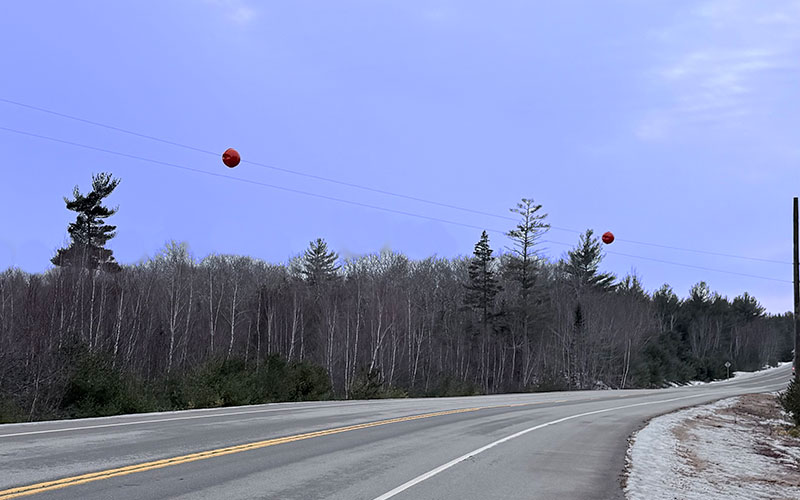
Until the MOOSE Net aerial build began, emergency helicopters had been able to land easily and safely at either the Great Wilderness Hunting Lodge on the west end of this segment of Route 9, or the sandpit on the east end, simply because both areas lacked the utility poles and hard-to-see overhead transmission wires that often endanger EMS flight crews. Wire strikes, including collisions with transmission lines, are a significant hazard and a leading cause of fatal medevac helicopter accidents. While not an everyday occurrence, these accidents happen often enough to be a major safety concern. With the MOOSE Net aerial construction adding cables and wires to the landscape, Maine Department of Transportation (MDOT) officials requested lifesaving safety measures.
Collaborating for Rapid, Practical Solutions
Sertex worked closely with the Maine Connectivity Authority (MCA), MDOT, Wesley Fire Department, and LifeFlight of Maine emergency services to ensure pilot and crew safety by engineering and installing aerial marker balls on overhead wires near both helicopter landing zones to improve visibility and reduce risk during emergency landings. Work is scheduled to be completed in January 2026.
While timelines may continue to evolve on the MOOSE Net buildout, overall project completion is currently projected for 2027. As this work moves forward, it reflects Sertex and MCA’s broader commitment to expanding connectivity in rural Maine without compromising the safety of those who live, work, and travel there
